

What to Wear to
Paris Fashion
Week
Espace Cléry, 17 Rue de Cléry
2nd arrondissement · Paris
There is no dress code at The Bureau’s publicly ticketed Paris Fashion Week show — nobody checks your outfit at the door of Espace Cléry. But Paris during fashion week is the most photographed week in fashion, so dress like you mean it. The working formula for October 2–3, 2026: a structured outer layer that’s part of the look (early October means crisp days, cool evenings, and a real chance of rain), one clear statement styled clean, and shoes that can handle the Sentier’s cobblestones — because the garment-district streets outside the venue are the photo op.
What to Wear to Paris Fashion Week Starts With One Fact: There’s No Dress Code
First, the anxiety-killer: you cannot be turned away from The Bureau’s Paris Fashion Week show for what you’re wearing. There is no written dress code, no clipboard, no once-over at the door of Espace Cléry. The Bureau’s Paris event is its own independently produced fashion week during the Paris Fashion Week season, and it is publicly ticketed — anyone can attend. That’s different from the official FHCM calendar shows, which are invite-only industry events; this guide is about the runway you can actually get into, so we’ll keep the access talk short. Your ticket is your access. The outfit is your choice.
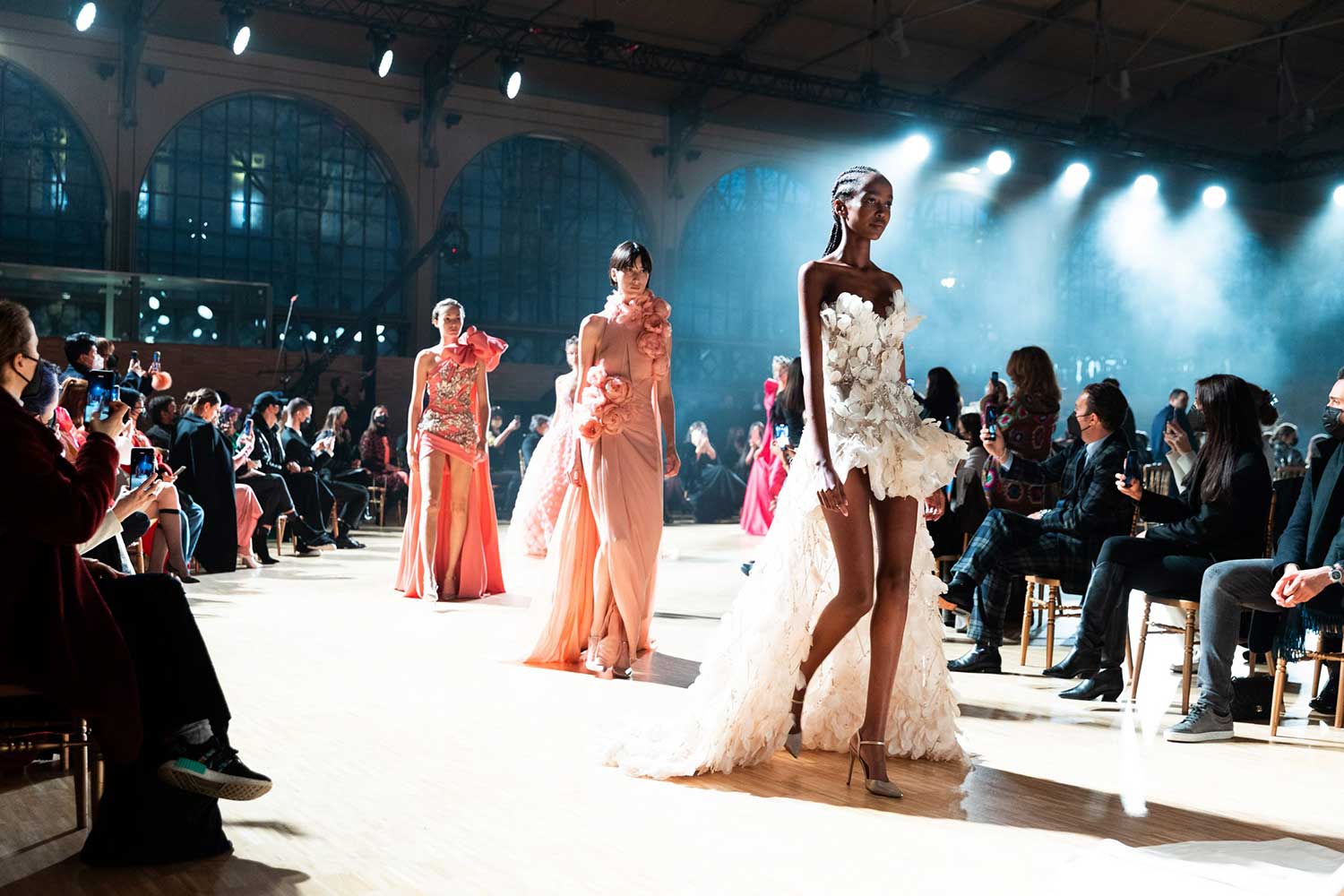
Now the honest part. Paris during fashion week is the most photographed week in fashion — street photographers, guest content, editors shooting between shows, and an entire city that treats getting dressed as a native skill. The audience dresses like it’s part of the show because, culturally, it is. The person next to you put real thought into their look, and the unspoken agreement is that you did too. “Elevated” is the word that covers it: not necessarily expensive, not necessarily formal, but considered. An outfit with a decision in it.
And the bar is intent, not budget. Parisian style has never been about volume — it’s precision: a perfectly cut coat, trousers that actually fit, one texture doing the talking. A flawless all-black look from anywhere beats an expensive outfit worn without conviction. Vintage reads brilliantly here — fitting, since the show sits in the Sentier, the neighborhood where Paris has cut, stitched, and wholesaled clothes for well over a century. What reads underdressed isn’t casual clothing; it’s accidental clothing — the outfit you’d wear to run errands, worn because you didn’t think about it.
Crisp Days, Cool Evenings, and the Layer That Is the Look
Early October in Paris is proper autumn dressing weather — which is to say, the best dressing weather there is. Days are typically crisp rather than cold, evenings turn genuinely cool once the light goes, and rain is always a live possibility; check the forecast the week you fly, and assume at least one damp walk between Métro and venue. You’ll spend real time outdoors — the walk from Métro Sentier or Bonne Nouvelle, the moments on Rue de Cléry before doors, the street-style shooting between shows — and real time indoors at the show itself. Every look has to survive both.
The answer is the most Parisian idea in fashion: the layer is not an accessory to the outfit — it is the outfit. A trench worn like armor. A wool blazer with real shoulders. A leather jacket over something fluid. A heavyweight knit that holds its shape. This is the piece you’ll be wearing in exactly the moments photographs happen — outside the venue, on the street, at golden hour — so it cannot be the “just in case” jacket from the back of the closet. That jacket will be in every exterior shot of your fashion week. Choose accordingly.
Two practical notes. First, fabrics: October in Paris rewards weight and texture — wool, leather, suede, heavy cotton, knits — and those fabrics also photograph better than anything flimsy in autumn light. Second, rain strategy: a trench or structured coat that shrugs off drizzle beats an umbrella you have to manage all day, and if you do carry one, make it small enough to disappear into your bag. Whatever you bring outside, you carry all show long — so a coat you can wear beats a coat you have to hold.
The Garment District Is the Photo Op
Here’s what makes dressing for this particular show different from dressing for a hotel ballroom: the venue is Espace Cléry, on Rue de Cléry in the 2nd arrondissement’s Sentier — Paris’s historic garment district, where the city’s rag trade of textile wholesalers, ateliers, and pattern makers has operated for well over a century. The streets around the venue are narrow, textured, and unmistakably Parisian — and during fashion week, they become the backdrop. Your best photos of the weekend will almost certainly happen outside, not inside.
That changes the brief in two ways. One: dress for the street, not just the seat. The look that reads at three meters in a runway room also needs to read at thirty meters on a Paris street — which is why silhouette and one strong color decision beat intricate details every time. Shoot before doors open and in the soft light after the show; the creator guide maps the full shot list. Two: respect the cobblestones. Old Paris streets are beautiful and utterly indifferent to your stilettos. Comfortable, stable shoes aren’t a compromise here — they’re the difference between walking those streets like you belong and picking your way across them like a tourist.
The 2nd arrondissement is central and walkable, and Métro Sentier (line 3) and Bonne Nouvelle (lines 8/9) are the closest stops — so plan on your shoes doing actual Paris distance, not just venue distance. Sharp flats, loafers, boots with a real sole, and genuinely clean sneakers are all fully at home at fashion week and have owned the street-style canon for a decade. If heels are essential to a look, make them block heels, break them in before the trip, and know your night has a taxi in it.
What to Wear to Paris Fashion Week, Seat by Seat
Every guest watches the same runway, but your ticket tier — and what you’re there to do — shapes the styling logic. The Bureau’s Paris show runs three qualitative tiers: General Admission, Premium Seating, and Front Row VIP — all on sale now, with current pricing on the tickets page (the tickets & cost guide covers how the tiers work). Here’s the dressing brief for each:
| General Admission | All-day endurance, styled sharp. You’re doing the full Paris day around the show — Métro, cobblestones, cafés, queue time. Great trousers or a dress that moves, a structured layer, a flat or block-heeled shoe you trust completely, a small bag that closes. Some of the best-dressed people at any Bureau show are in GA; the tier has never once been visible in an outfit. |
| Premium Seating | The balanced brief. The upgraded vantage without front-row visibility pressure — dress purely to the slot: crisp and light for day, darker and richer for evening. This is the tier where you can take the most styling risk with the least logistical penalty. |
| Front Row VIP | Statement dressing. Row 1 sits in the background of runway photography all show long. Polished, evening-leaning fabrics, jewelry that reads on camera, and shoes chosen to be seen — because your feet are in frame. You’re seated; comfort constraints relax, visibility constraints tighten. |
| Creators & street style | Dress for the lens first. One silhouette readable from across the street, one saturated color block or perfect monochrome, texture that plays with autumn light. The Sentier is your set — but you’ll shoot standing, walking, and crouching on cobblestones, so the shoe rule is non-negotiable. |
A word on men’s and androgynous dressing, because it’s the most under-served question in fashion week guides — and Paris is the easiest city on earth to answer it. Tailoring is the win: a well-cut suit or a strong blazer over a fine knit, tonal layering, one texture play — suede, leather, an open collar under structure. Skip the office-default shirt-and-chinos energy and add one deliberate move. And fashion week is one of the few rooms where gender-fluid dressing isn’t just accepted but photographed enthusiastically; the runway crowd rewards a point of view far more than it rewards convention.
Convert the Look, Don’t Change the Costume
Two show days — Friday and Saturday, October 2–3, 2026, with five runway shows between them — mean the smart play is a wardrobe that converts, not a costume per slot. The lineup is announced soon and ticket holders hear first (the schedule page carries the show times), but the rhythm of every fashion week is the same: daytime rooms are brighter and more street-style-driven; evening rooms are darker, dressier, and more deliberate. Save your one knockout look for your dressiest evening slot — Saturday night closes the season with the finale — and let everything else flex.
The conversion kit is small: swap the layer, change the shoe, add jewelry, shift the bag. A crisp daytime look — great trousers, fine knit, trench — darkens into an evening one with a sharper jacket, a finishing shoe, and one piece of jewelry that reads across a room. Parisian evenings in October are cool enough that the outer layer stays in the look all night, which works in your favor: the coat is the evening statement half the time in this city. Plan each day as one base with a night conversion and you’ll never carry more than a small bag can hold.
If Paris is one stop on a bigger season, the same capsule travels: New York Fashion Week runs September 11–13, 2026 at Gotham Hall (tickets are on sale now), and LA Fashion Week follows October 16–18 at The Lot Studios — two weeks after Paris, one wardrobe apart. How the dressing logic shifts between cities is its own subject; the NYFW vs Paris guide covers the honest comparison.
The Short List of Actual Misses
Nothing is banned — read this as pattern recognition, not rules. Three things consistently read wrong at a fashion week, and Paris adds its own physics to two of them:
| Oversized bags | A big tote fights your silhouette in every photo and everyone’s knees in a full room — and it’s the single most common styling regret at any show. Carry a bag that closes and holds exactly phone, charger, ticket, lipstick. Leave the rest at the hotel; the 2nd arrondissement is central enough to go back. |
| Unbroken heels | New stilettos plus Sentier cobblestones is an equation with one outcome. If heels are the look, make them block heels, walk them in for a week before the trip, and pack the flat backup. Fashion week is a terrible place to meet your shoes for the first time. |
| Accidental clothing | The outfit with no decision in it — worn because it was clean, not because it was chosen. One styling move fixes it: a layer, a shoe, jewelry, a tuck. In the most photographed week in fashion, unconsidered is the only real miss. |
The Paris Capsule, in One Paragraph
For the show weekend: one structured outer layer that anchors every look (trench, wool blazer, or leather), two interchangeable bases (trousers + knit, a dress that works day or night), one evening statement piece for your dressiest slot, one walkable finishing shoe plus one backup, one small bag that closes, and jewelry that converts day to night. That’s it — six decisions, nine looks. The full suitcase-level strategy, from chargers to steamer substitutes, is in the fashion week packing list — written for New York, and every line of it travels.
Run every look through one filter the night before: would I be happy to end up in a stranger’s photo in this? In Paris, during fashion week, you probably will. That question — not any rulebook — is the real dress code. For everything beyond the outfit, start with how to attend Paris Fashion Week.
The Outfit Needs a Runway
Paris Fashion Week by The Bureau · October 2–3, 2026 · Espace Cléry, 17 Rue de Cléry, 2nd arrondissement. Tickets are on sale now in three tiers — General Admission, Premium Seating, and Front Row VIP — and pricing rises as the season approaches.
Get TicketsCan’t make October? Join the March 2027 waitlist.